
Digital 4 Peace: PeaceAbility – Empowering Persons with Disabilities from Exclusion to Influence in Thailand’s Deep South
On September 25, 2025, the PeaceAbility project organized a transformative workshop at Prince of Songkla University’s Pattani Campus, addressing the systemic exclusion of Persons with Disabilities (PWDs) from peace and development decision-making processes in Thailand’s Southern Border Provinces. This initiative aimed to elevate PWDs from policy subjects to policy shapers in a region where long-standing conflict has disproportionately affected their lives. Through the small grant, Digital 4 Peace built rights literacy, translated lived experience into policy, and secured on-record commitments from authorities–while launching a digital accountability hub.
Key Achievements
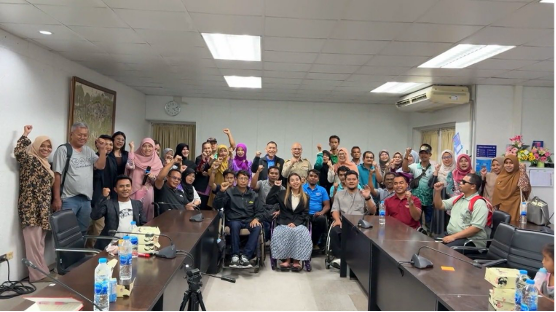
- Participation: 45 attendees, including 31 PWDs with diverse disabilities, 12 personal assistants, and 2 senior government officials.
- Capacity Building: Intensive training on Thai/International disability law, rights-based development, policy frameworks, and practical advocacy strategies.
- Policy Creation: A unified “Declaration of Persons with Disabilities for Participation in Inclusive Peace and Development” with 6 core demands.
- Government Engagement: SBPAC and PAO accepted the Declaration and made budget/strategy commitments.
- Digital Innovation: Accessible, multilingual website for transparency, progress tracking, and feedback.
Workshop Structure
The workshop as structured as a progression from capacity building to empowerment and influence:
1. Capacity Building: Expert-led sessions (Fathoni University, Digital4Peace) grounded in Thai disability laws, international standards, human rights-based development approaches and frameworks, and case-led practice.
2. Participatory Design: Using a ‘Worl Cafe’ format, participants mapped barriers and co-synthesized insights in real time into the 6-pillar Declaration, capturing six core demands: permanent representation; universal design in civic infrastructure; trauma-informed protection/justice pathways; inclusive teacher training/materials; market-linked vocational pathways; entrepreneurship support.
3. Policy Dialogue: Mr. Abdulloh Wamae, representative of the Southern Border Provinces Administrative Center (SBPAC) Advisory Council, and Mr. Chaturon lamsopha, Vice President of te Pattani Public Affairs Office (PAC) made key commitments. SBPAC invited a PWD representative to present the Declaration at its Advisory Council meeting and offered immediate linkages to community budgets for accessibility renovations. The PAO pledged to ue the Declaration to guide strategic planning and budget allocation.
4. Digital Platform: Launch of a website which hosts the Declaration, participant profiles, progress tracking, and resource in multiple languags (Thai/Patani Malay/English). The site also features a live progress tracker of SBPAC/PAO actions against the six policy pillars–keeping inclusion visible, measurable, and ongoing.
Outcomes
- Training-to-policy pathway: One unified Declaration adopted.
- Grassroots-to-government bridge: Six partner organizations; direct, public handover with specific commitments.
- Empowerment: Advocacy confidence +68 points; rights knowledge +56 points; 95.3& found it valuable/highly valuable.
- Network effects: Cohesive PWD advocacy community with shared language, evidence, and tools.
Impact and Significance
- Knowledge to power: Measurable gains in confidence and rights literacy catalyse sustained advocacy.
- From margins to mainstream: Government commitments elevated disability inclusion in local policy agendas; significant media coverage (including NBT11) amplified reach.
- Sustainability: Digital hub sustains visibility, accountability, and community reporting.
- Replicable: Practical blueprint for conflict-affected settings.
- Narrative shift: Positions accessibility as a governance obligation, not charity.
Sustainability and Looking Ahead
As the Declaration moves from paper to practice, the test of success is implementation against the six pillars. The platform will track SBPAC/PAO follow-through, support community oversight, and document change. With continued coalition support, this approach can scale across the Deep South and inform national practice. By briding the gap between grassroots advocacy and institutional policy-making, it offers a powerful example of how targeted interventions can drive meaningful, and sustainable change.
This impactful initiative was made possible through a broad coalition of local and international partners, incuding Digital4Peace Foundation, Club for Empowerment for Disabled Friends, The Association of the Physically Handicapped of Narathiwat, Southern Association of Disabilities, Centre for Conflict Studies and Cultural Diversity (CSCD), and the Institute for Peace Studies at Prince of Songkla University.
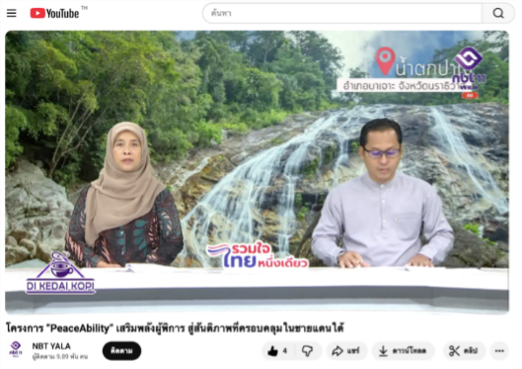
Screenshot of the National Broadcasting Services of Thailand (NBT11) news segment covering the PeaceAbility Project, broadcast regionally on TV and YouTube. The coverage was published in the Southern Region and included reporting in the local Malay language, amplifying the project’s message across the Deep South.(Link: https://www.youtube.com/watch?v=5FOOSy4sdsc). September 2025.
Follow the Peacemakers Network on social