
Beyond the Margins: Centering Disability-Inclusion in the Architecture of Peace – A Global Toolkit for Advancing Persons with Disabilities in Peacebuilding
December 2025
Too often, persons with disabilities are excluded from decision-making in times of conflict and recovery, despite being deeply affected by violence and already active in advancing peace within their communities.
Grounded in the belief that peace cannot be just or sustainable without disability inclusion at every stage of the peacebuilding cycle, the Peacemakers Network, the Abilis Foundation, and Finn Church Aid (FCA) have launched a new global resource, “Beyond the Margins: Centering Disability-Inclusion in the Architecture of Peace, A Global Toolkit for Advancing Persons with Disabilities in Peacebuilding.” This toolkit outlines opportunities, recommended actions, and systemic shifts necessary to support the leadership, protection, and participation of persons with disabilities in building and sustaining peace.
Designed as a hands-on guide for governments, civil society, peace practitioners, and donors, the toolkit and its accompanying framing guide provide specific entry points for change to advance the inclusion of persons with disabilities and organizations of persons with disabilities (OPDs) across the prevention, response, and recovery stages of conflict. Further, it draws on insights from the STRONG project implemented by Finn Church Aid in Somalia, offering real-world insights that can be adapted for diverse local contexts.
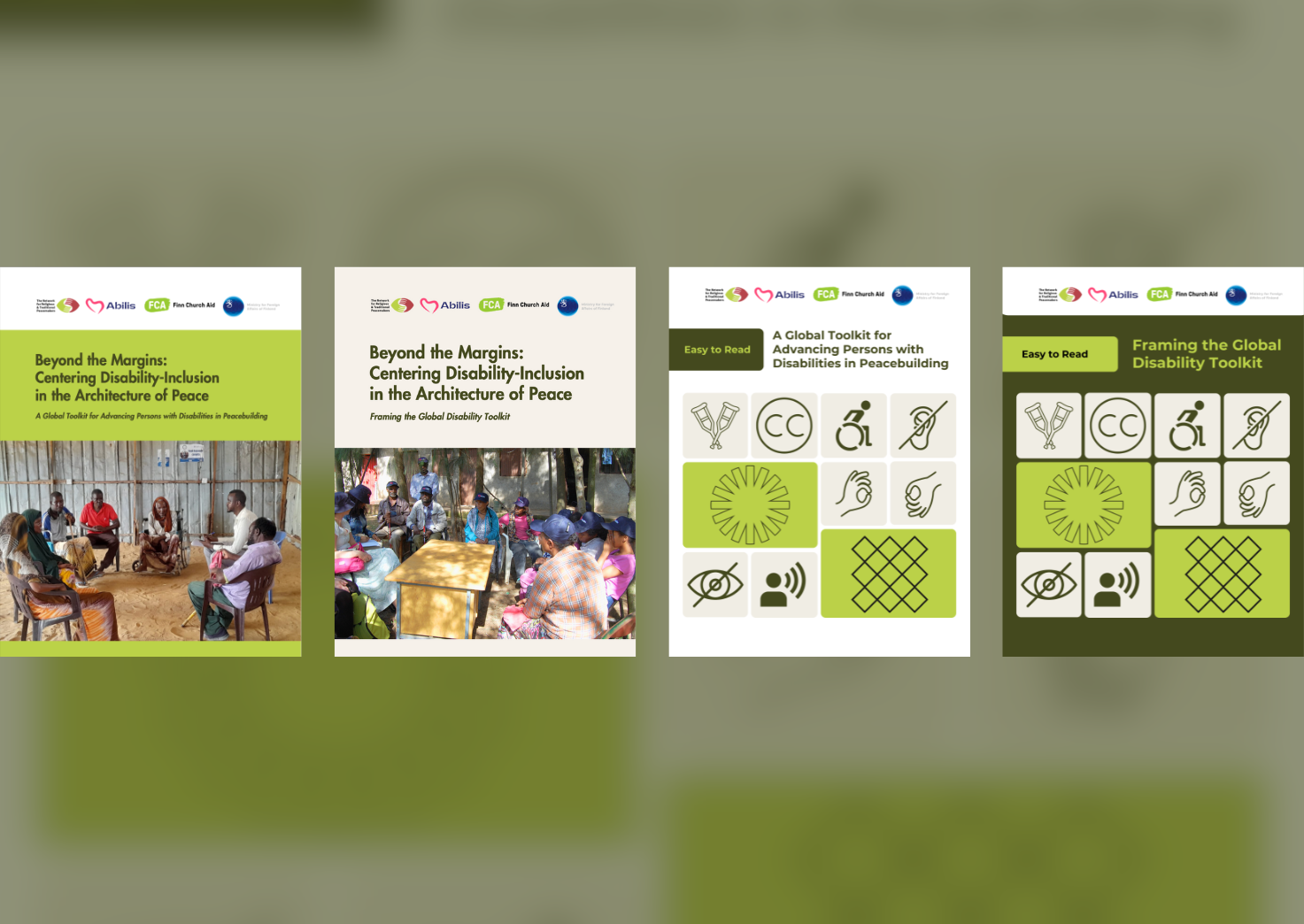
Access the full formats of the global toolkit and framing of the toolkit.
Access the easy-to-read version of the global toolkit and the easy-to-read version of the framing of the toolkit.
Persons with Disabilities in Peacebuilding
Disability inclusion must be embedded across all peacebuilding and development efforts. One of the most powerful tools for advancing the work of persons with disabilities is partnership. Meaningful partnerships, particularly with OPDs and disability leaders, should be prioritized across all phases of peacebuilding, from planning to implementation, monitoring, and evaluation. These collaborations strengthen the legitimacy, visibility, and sustainability of peacebuilding efforts, while supporting accessible systems rooted in community leadership.
Global commitments reinforce this responsibility. UNSCR 2475 calls for the full and effective consultation and participation of persons with disabilities across all stages of peace processes. This call builds on the 1982 World Programme of Action Concerning Disabled Persons, which urged Member States to invest in peaceful solutions to social exclusion, including through prevention and mediation, as well as the CRPD and the 2030 Agenda for Sustainable Development, also affirming the right to participation.
“Peace cannot be just or sustainable if persons with disabilities are left out of the decisions that shape their lives. This toolkit makes clear that disability inclusion is not a technical add-on; it is a political imperative and a test of whether our peace systems truly serve everyone. Inclusive peace is only possible when peacebuilding organizations and Organizations of Persons with Disabilities work as equal partners. This toolkit offers a roadmap for transforming our systems so that the leadership of Persons with Disabilities is not the exception, but the norm,” shared Jessica Roland, Senior Specialist for Inclusive Peace at the Peacemakers Network.
By organizing actions across the individual, institutional, and socio-cultural levels, the toolkit highlights how peacebuilding must be reimagined from the ground up, through inclusive early warning systems, equitable access to justice, accessible infrastructure, participatory governance, and trauma-informed healing. The case study from Somalia reinforces that inclusion is not aspirational; it is achievable.
Advancing the inclusion of persons with disabilities: Somalia as a Case Study
Somalia faces one of the most complex peacebuilding challenges in the world. With decades of civil war, political fragmentation, and recurrent humanitarian crises, this has severely weakened state institutions, undermined social cohesion, and left millions displaced.
Against this backdrop, peacebuilding efforts have emerged both from within Somalia’s rich traditions of mediation and through support from international actors. Yet, these initiatives have often overlooked one critical dimension of inclusivity: the rights and participation of persons with disabilities. In a country where approximately 11.7 percent of the adult population lives with some form of disability, the intersection of disability and peace processes remains largely unexplored and under-addressed.
To continue addressing the barriers and needs of persons with disabilities in Somalia, Finn Church Aid (FCA) launched the, ‘Strengthening Democratic and Inclusive Local Governance’ (STRONG) project, in 2024, funded by the Swedish International Development Cooperation Agency (SIDA), in collaboration with Somalia’s Ministry of Interior, Federal Affairs and Reconciliation (MOIFAR) and the Abilis Foundation in Mogadishu, Somalia.
An assessment was commissioned on the status of inclusion of persons with disabilities into peace processes across four Federal Member States of Somalia, through identifying systemic gaps and opportunities to foster meaningful inclusion of persons with disabilities in reconciliation and governance efforts.
“Our work in the most fragile contexts in the world has shown that too often the most marginalized groups, such as people with disabilities, are left out from important processes and structures. Including everyone in the process of building peaceful and cohesive societies is the most important benchmark for real participation, democratization, and inclusivity. By including everyone, we strongly communicate our values in practice: no one is left behind,” emphasized Ikali Karvinen, Deputy Executive Director of Finn Church Aid.

‘Strengthening Democratic and Inclusive Local Governance in Somalia’, funded by the Government of Sweden (SIDA). 2024-2025. Photo: Finn Church Aid.
Looking Ahead
Inclusion of persons with disabilities in peacebuilding is a collective responsibility. It requires peace and security actors, from governments to civil society, religious and traditional leaders, and donors to recognize the agency, knowledge, and rights of persons with disabilities not as an afterthought, but as foundational to just and lasting peace.
Follow the Peacemakers Network on social